Launch offer — valid today only

📄 Digital book in PDF · read it on your phone or print it

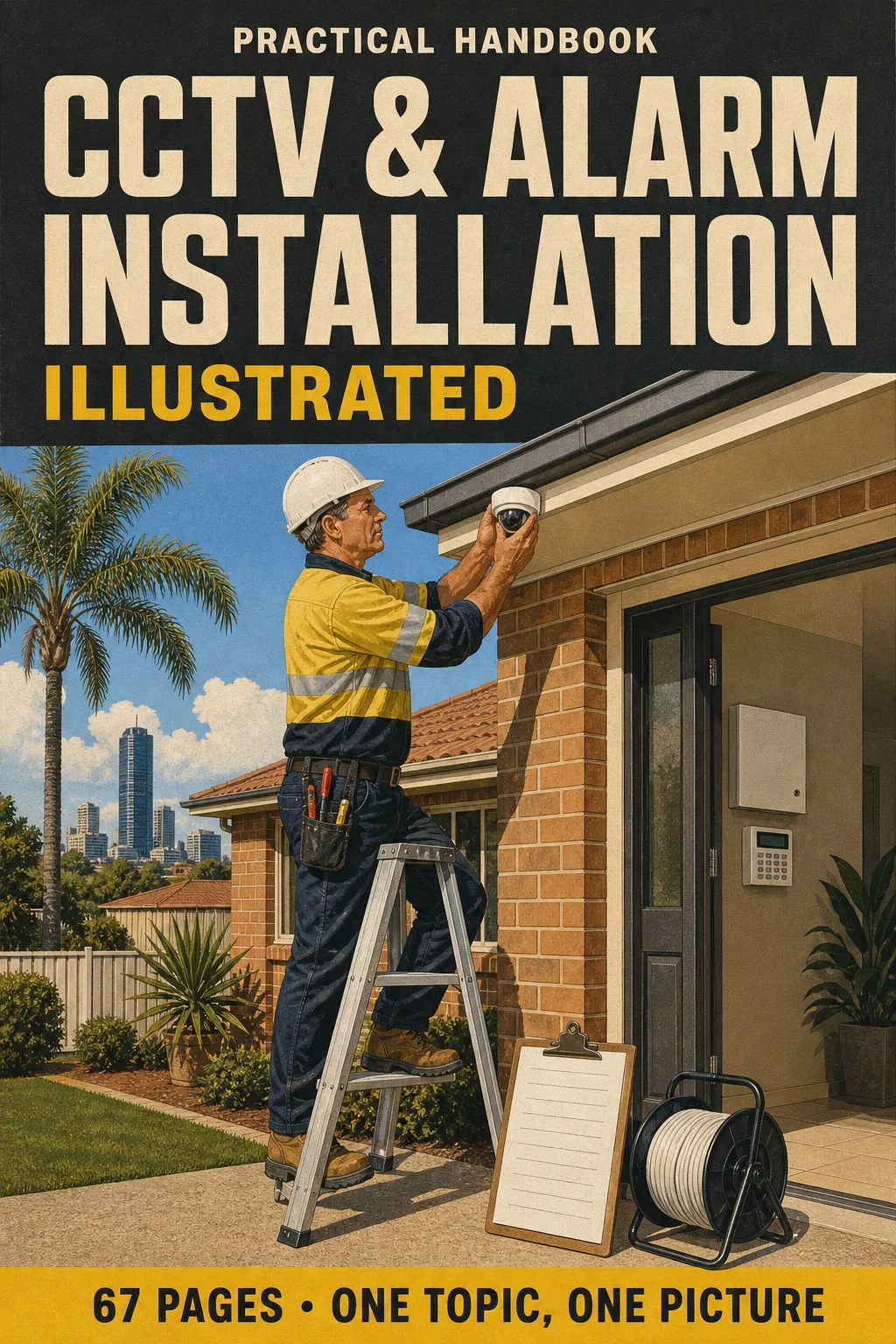
Intruder Alarms and CCTV to Australian Standards, in Drawings The Same Order on Every Job

PIR positions, zones and end-of-line resistors, 12 V cabling and battery standby, PoE, camera angles, night vision, recording days, commissioning and fault-finding. Every topic has its own page: the drawing first, then what you need to remember. 67 illustrated pages.

YES, I WANT THE BOOK + 2 BONUS BOOKS

🔒 Secure checkout · PDF by email · 30-day guarantee

Every topic, its own pageEvery detector, cable run and camera angle drawn, with the explanation beside it
67 illustrated pages9 parts, from the alarm as five blocks to the one-page job route
Up-to-date sourcesAS/NZS 2201.1, AS/NZS 3000 and AS/NZS 62676.4
PDF by emailFormat

Look Inside the Book

Every page has one big drawing and a box with the numbers and steps you need on site:

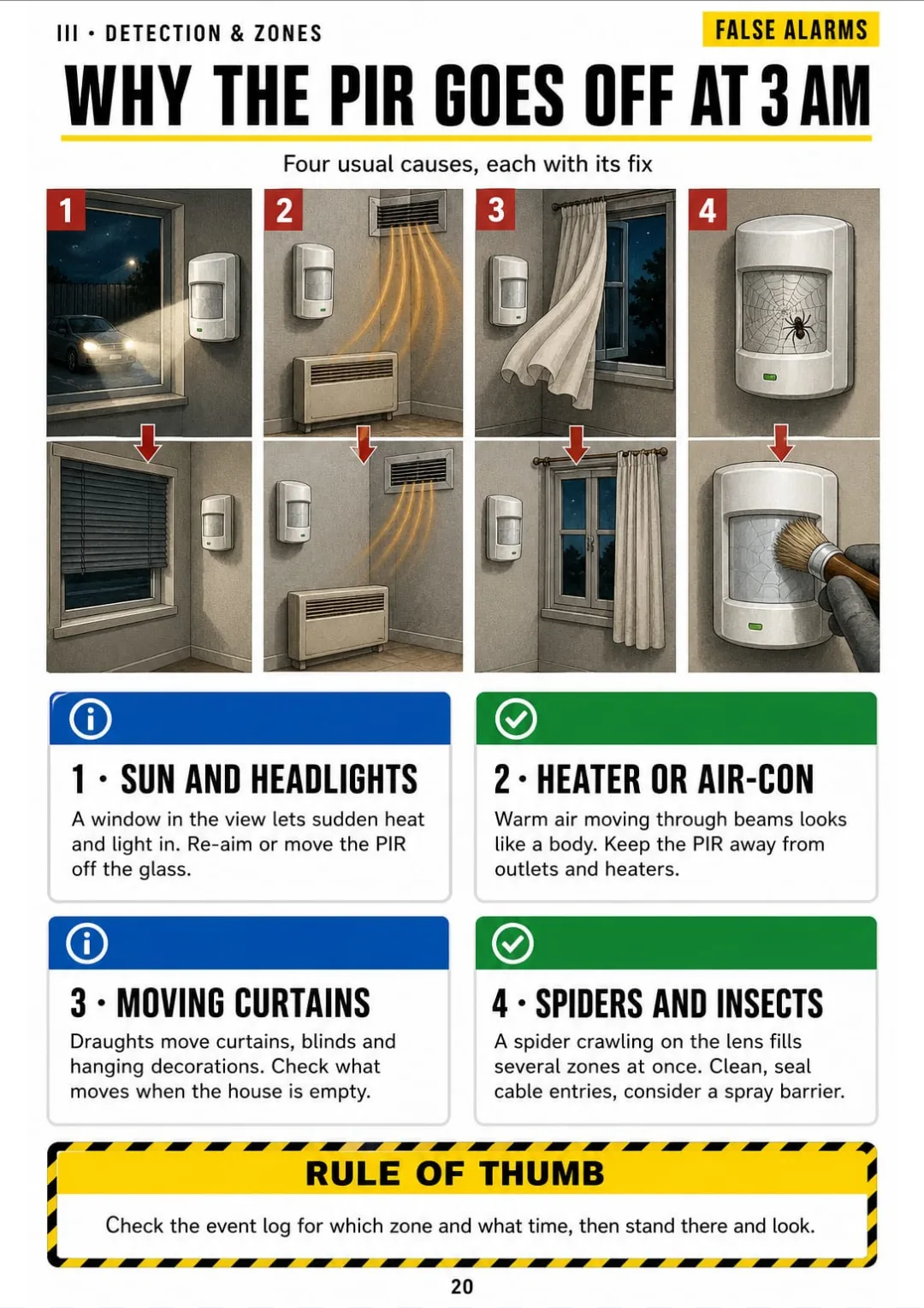
Four causes of the 3 am false alarm, each drawn with its fix.
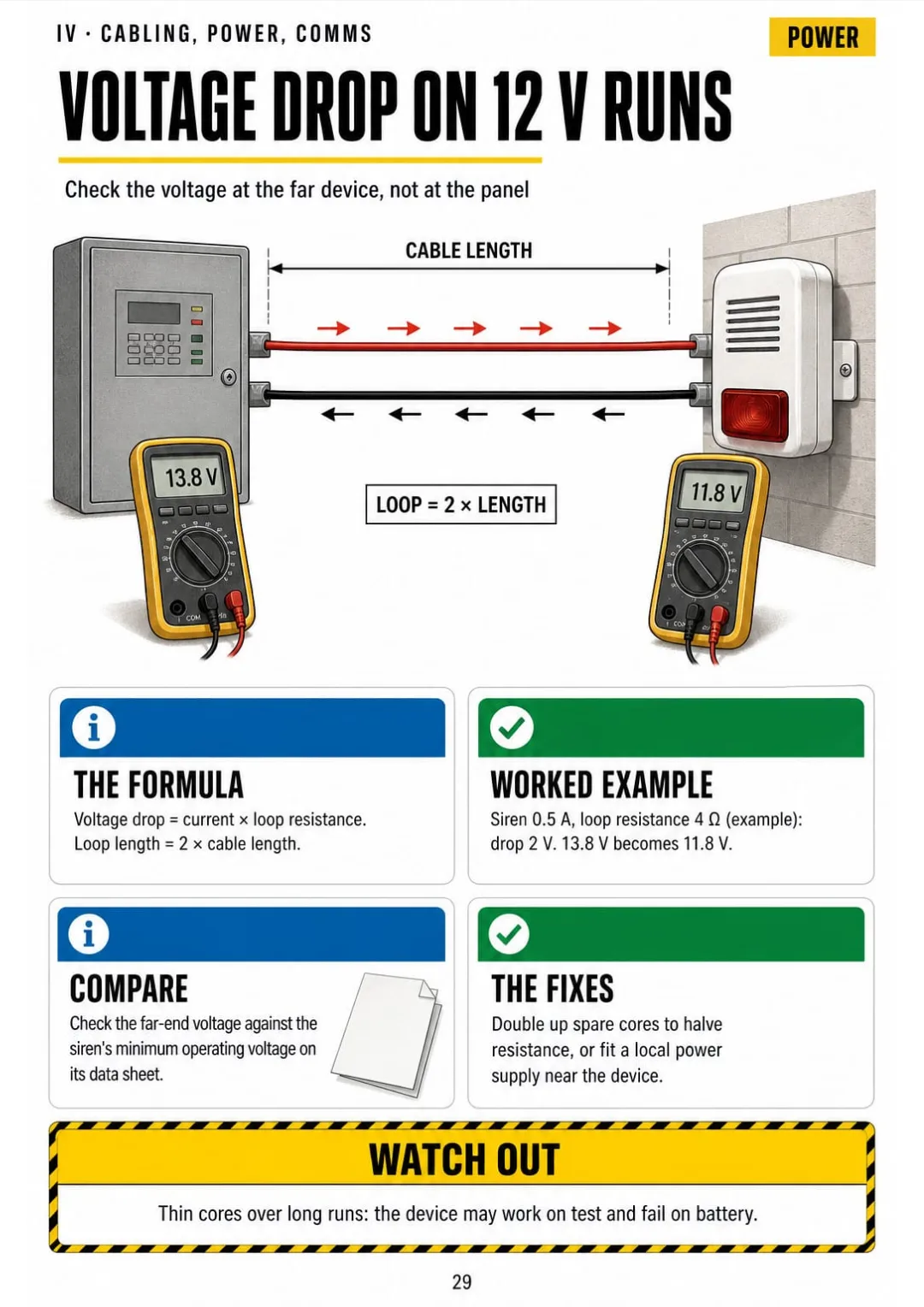
Voltage drop = current × loop resistance; loop length is twice the cable run
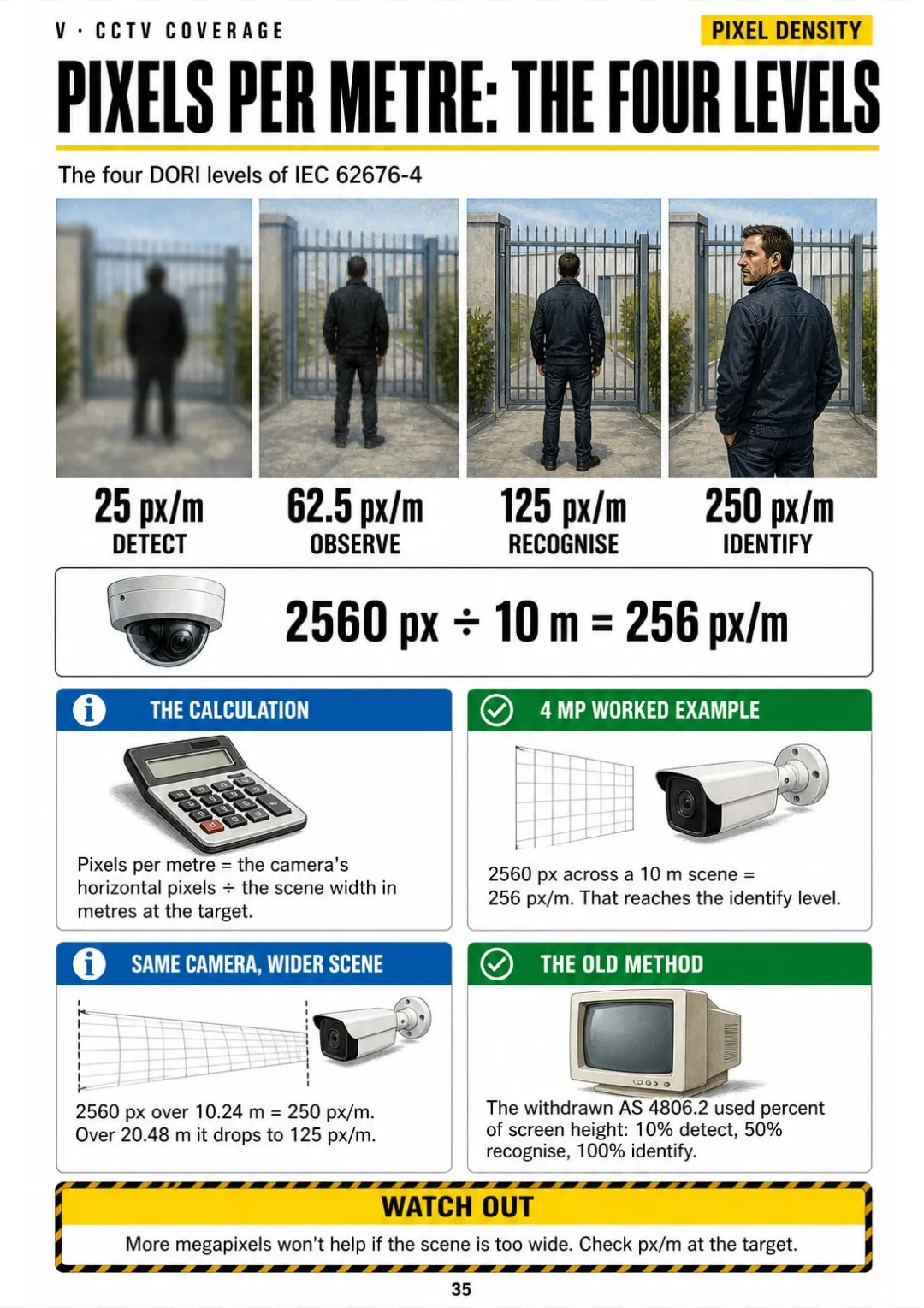
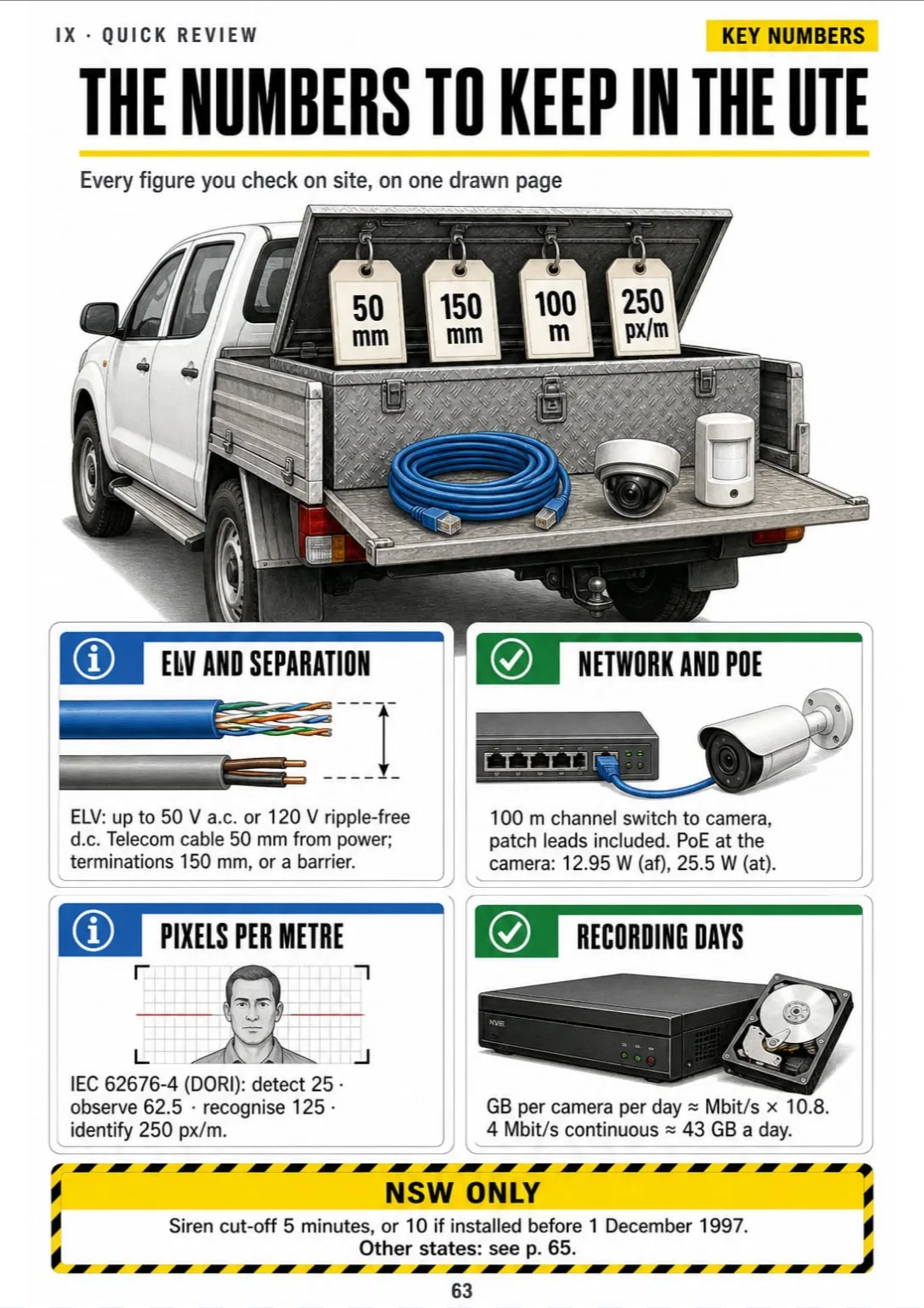
Detect 25 · observe 62.5 · recognise 125 · identify 250 px/m at the target (AS/NZS 62676.4:2020).
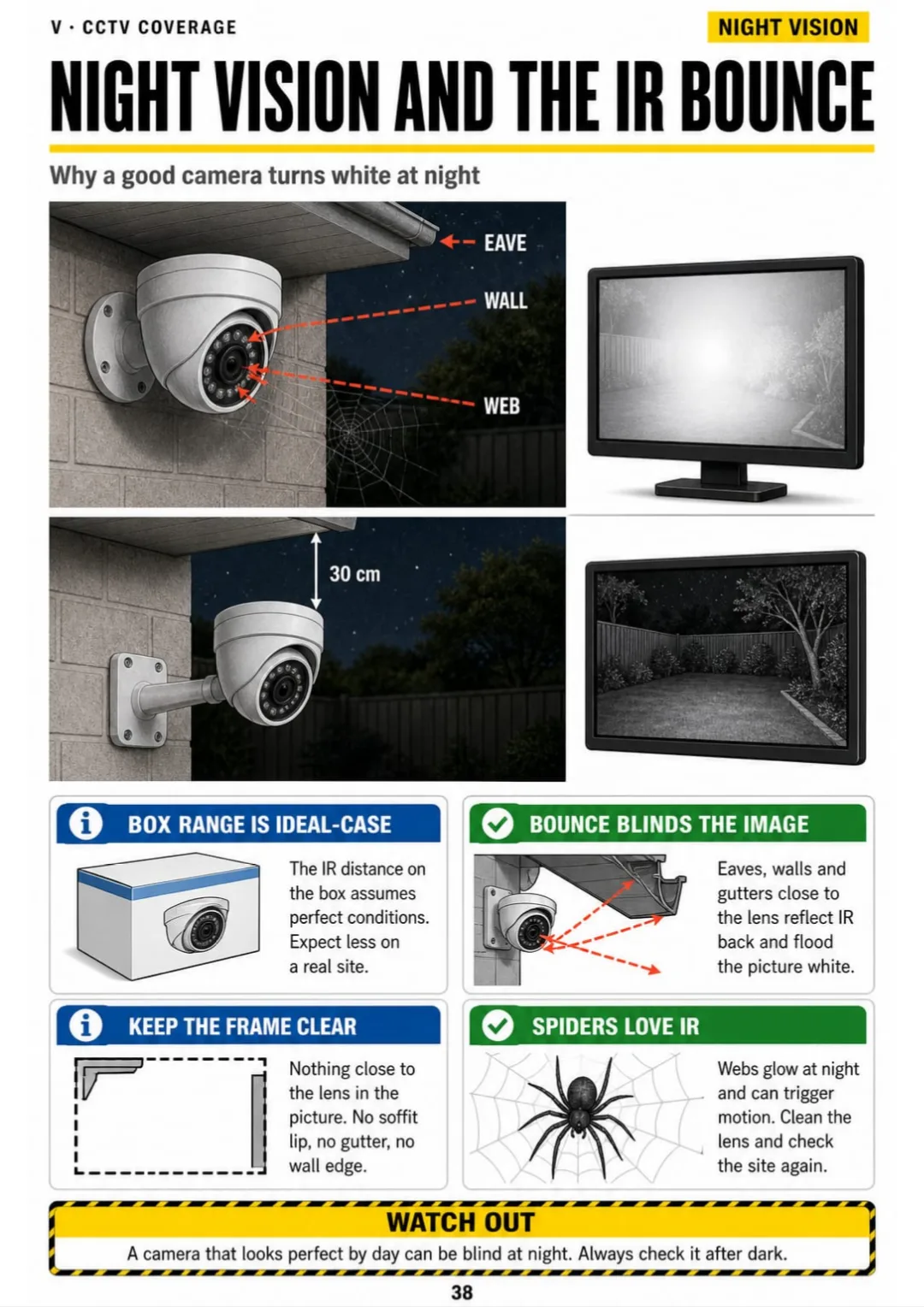
IR bounces off eaves, walls and cobwebs near the lens: keep the bottom of the frame clear.
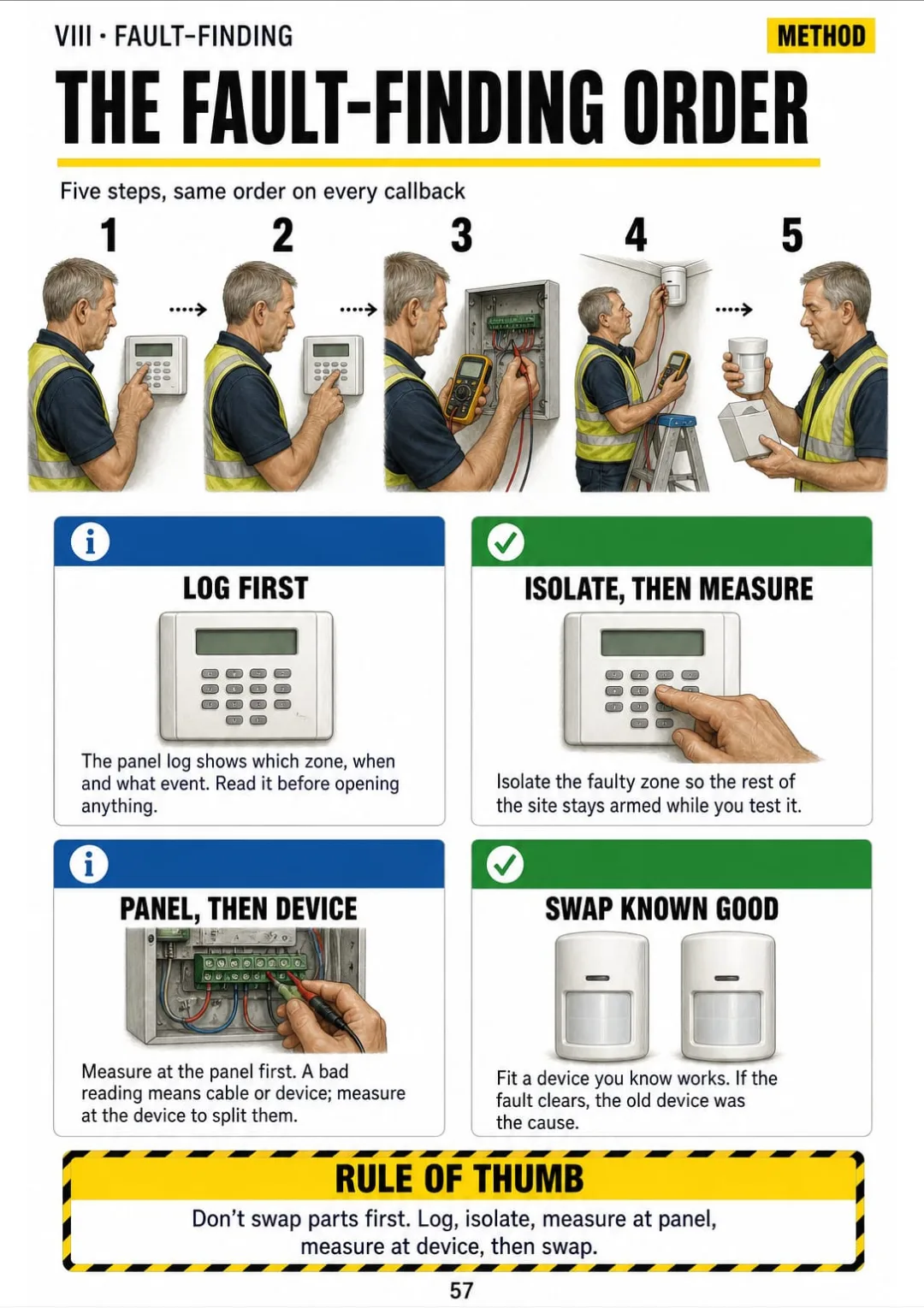
Log → isolate → measure at panel → measure at device → swap known good.
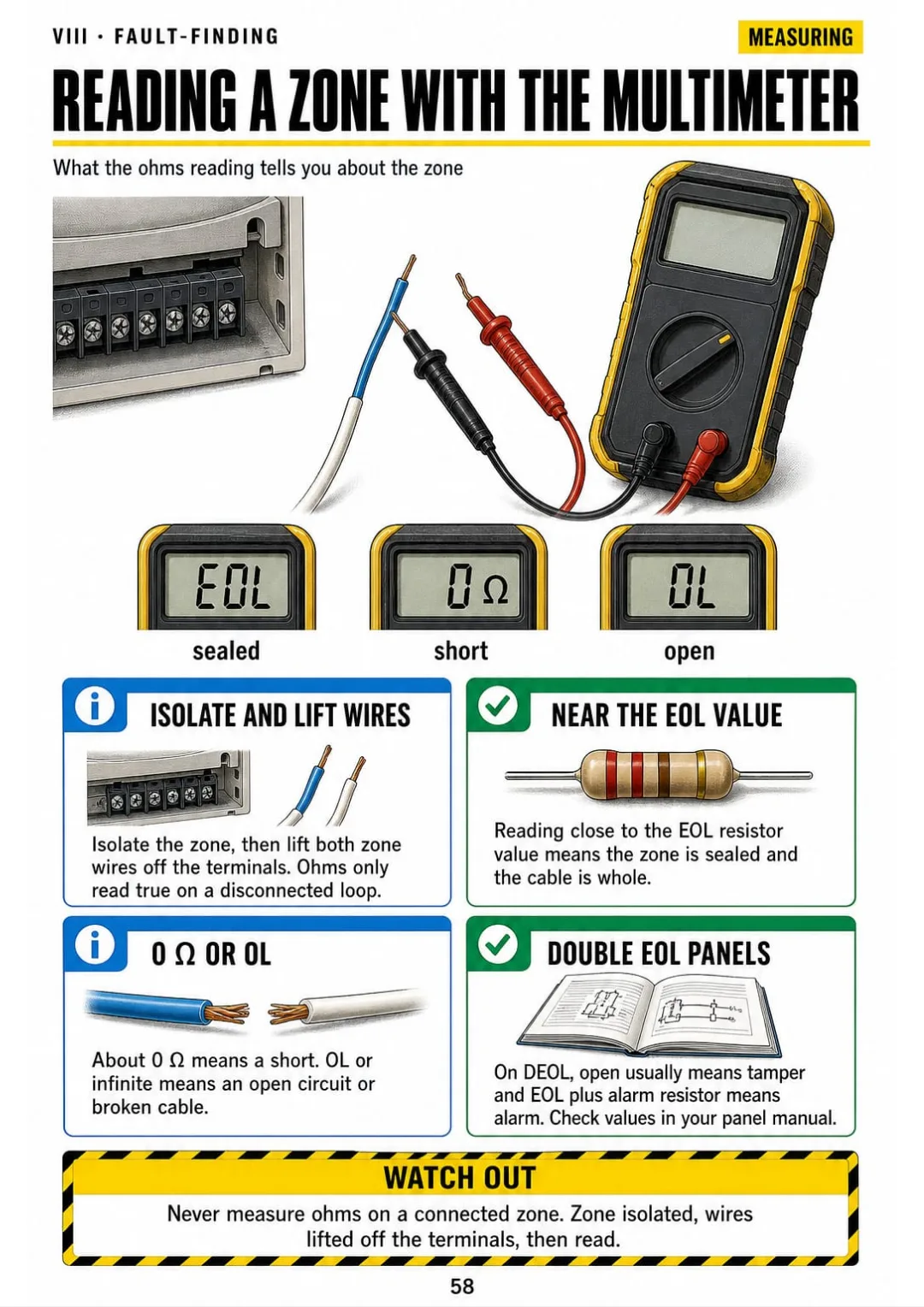
EOL value = sealed · 0 Ω = short · OL = open (DEOL tamper) · EOL + alarm resistor = DEOL alarm.
50 mm, 150 mm, 100 m, 25/62.5/125/250 px/m and Mbit/s × 10.8: the job's numbers, drawn
8 states and territories: licence regulator, surveillance law and siren cut-off, marked VERIFY

Swipe to see more →

These are real pages from the book. The table of contents is the full one: 9 parts and 63 topics.

The Problem Isn't You. It's How It Was Explained.

You're up a ladder at the front of a shop, camera in hand, and the owner asks: "Will I actually be able to see who it is?"

You've read about pixels per metre in spec sheets and guidance notes. It's all paragraphs: resolution, lens, distance, target. On the ladder, none of it adds up to an answer.

Detect 25 · observe 62.5 · recognise 125 · identify 250 px/m at the target (AS/NZS 62676.4:2020).

In the book it's one page. Four figures at the target, each drawn at its level: detect 25, observe 62.5, recognise 125, identify 250 pixels per metre. Beside each one, what that level lets you see on screen.

Same for PIR positions, end-of-line resistors, voltage drop on 12 V runs, PoE classes and recording days: each one has its own page.

So you pick the camera and lens before you quote, tell the owner what he'll see, and you do it without going back to the manual.

COMPARE FOR YOURSELF

The Same Topic, Two Ways to Learn It

THIS
  • The manual: line after line of text
  • Voltage drop explained only in words
  • You get to the job still unsure
Voltage drop in extra-low voltage alarm circuits shall be determined from the total resistance of the conductors forming the supply loop, which comprises both the positive and negative conductors and is therefore equal to twice the route length of the cable to the device. The resulting voltage drop is the product of the aggregate current drawn by all devices on the circuit and said loop resistance, and the installer should verify that the terminal voltage at the most distant device remains within the manufacturer's operating range.
FOR THIS
  • Voltage drop on a 12 V run in one drawing
  • The formula and the loop length in a box
  • You see it and it makes sense
Voltage drop = current × loop resistance; loop length is twice the cable run
CONTENTS

Take a Look at the 9 Parts and 63 Topics

How the systems fit together, planning, detection and zones, alarm cabling, cameras and coverage, network and recording, commissioning, fault-finding and quick review: 67 pages, all illustrated.

IHow the Systems Fit Together · pp. 5-10
  1. The intruder alarm as five blocks
  2. CCTV end to end
  3. The job route: same order every time
  4. Where your electrical licence stops
  5. Extra-low voltage vs low voltage on the same job
  6. Privacy and surveillance rules in one page
IIPlanning the Job · pp. 11-17
  1. The site walk: what to look at
  2. Risk first, devices second
  3. Marking up the floor plan
  4. Choosing wired, wireless or hybrid
  5. Choosing camera type and lens before you quote
  6. Monitoring and comms options
  7. The quote checklist
IIIAlarm Detection and Zones · pp. 18-26
  1. How a PIR actually sees
  2. PIR mounting height and position
  3. Why the PIR goes off at 3 am
  4. Pet-immune detectors done right
  5. Reed switches on doors and windows
  6. Other detectors: dual tech, glass break, outdoor
  7. Zone types in plain words
  8. End-of-line resistors: what they tell the panel
  9. The zone schedule
IVAlarm Cabling, Power and Comms · pp. 27-33
  1. Cable choice for alarm devices
  2. Star wiring vs daisy chain
  3. Voltage drop on 12 V runs
  4. Battery standby sizing
  5. Siren and strobe placement
  6. Tamper circuits and the panel box
  7. Communicators: 4G, IP and the test call
VCCTV Cameras and Coverage · pp. 34-42
  1. Field of view in metres
  2. Pixels per metre: detect, recognise, identify
  3. Mounting height and tilt
  4. The white-out entrance: backlight and sun
  5. Night vision and the IR bounce
  6. Colour at night and white-light cameras
  7. Covering a house: the four-camera layout
  8. Weatherproofing the mount
  9. Pointing away from neighbours
VINetwork, PoE and Recording · pp. 43-50
  1. PoE power classes
  2. The 100-metre rule
  3. Terminating Cat6 for cameras
  4. NVR, switch and router layout
  5. How many days will the drive record?
  6. Bitrate, H.265 and frame rate
  7. Motion and smart detection setup
  8. Remote access without leaving the door open
VIICommissioning and Handover · pp. 51-56
  1. Walk test every detector
  2. Testing tampers, siren and battery
  3. Confirming signals with monitoring
  4. Checking every camera by day and by night
  5. Handover: what the customer must be able to do
  6. The handover record
VIIIFault-Finding · pp. 57-62
  1. The fault-finding order
  2. Reading a zone with the multimeter
  3. False alarms: the usual suspects
  4. Panel won't arm or keeps beeping
  5. Camera drops out or reboots
  6. Blurry, white or black picture
IXQuick Review · pp. 63-67
  1. The numbers to keep in the ute
  2. Most frequent install mistakes
  3. State-by-state check list
  4. Blank floor plan and zone schedule
  5. The one-page job route

One Page, One Topic, All Clear

Think of it this way:

It's a new build, the plasterer is in tomorrow, and you have to decide now where the hallway PIR goes and which way it faces. Get it wrong and the phone rings at 3 am.

You open the book at PIR mounting height and position. The detector is drawn from the side and from above, with its detection pattern and what to keep out of its view.

Log → isolate → measure at panel → measure at device → swap known good.

Same with end-of-line resistors, PoE power classes, the 100-metre rule, recording days and the handover: each one on its own page.

CCTV & Alarm Installation Illustrated is 9 parts and 63 topics, all drawn, and at the end the job's numbers, a state-by-state check list and blank floor plans and zone schedules.

What you see drawn, you don't have to memorize.

What's Inside CCTV & Alarm Installation Illustrated:

Ipp. 5-10

How the Systems Fit Together

The alarm as five blocks, CCTV end to end, the job route, where your electrical licence stops, ELV and LV on the same job, and privacy and surveillance rules.

IIpp. 11-17

Planning the Job

The site walk, risk before devices, marking up the floor plan, wired or wireless, camera and lens choice, monitoring options and the quote checklist.

IIIpp. 18-26

Alarm Detection and Zones

How a PIR sees, mounting height, the 3 am false alarm, pet-immune detectors, reed switches, other detectors, zone types, EOL resistors and the zone schedule.

IVpp. 27-33

Alarm Cabling, Power and Comms

Cable choice, star wiring vs daisy chain, voltage drop on 12 V runs, battery standby, siren and strobe placement, tampers and communicators.

Vpp. 34-42

CCTV Cameras and Coverage

Field of view in metres, pixels per metre, height and tilt, backlight and sun, IR bounce, colour at night, the four-camera house layout, weatherproofing and privacy.

VIpp. 43-50

Network, PoE and Recording

PoE classes, the 100-metre rule, terminating Cat6, NVR and switch layout, recording days, bitrate and H.265, smart detection and safe remote access.

VIIpp. 51-56

Commissioning and Handover

Walk tests, tampers, siren and battery, signals to monitoring, cameras by day and night, and what the customer must be able to do at handover.

VIIIpp. 57-62

Fault-Finding

The fault-finding order, reading a zone with the multimeter, false alarms, a panel that won't arm, cameras that drop out and bad pictures.

IXpp. 63-67

Quick Review

The numbers to keep in the ute, the most frequent install mistakes, a state-by-state check list, blank plans and the one-page job route.

At the end of the book: The job's numbers on one page, a state-by-state check list, blank floor plans and zone schedules, and the one-page job route.
Plus: 2 Free Books

Alarm & CCTV Fault-Finding Casebook

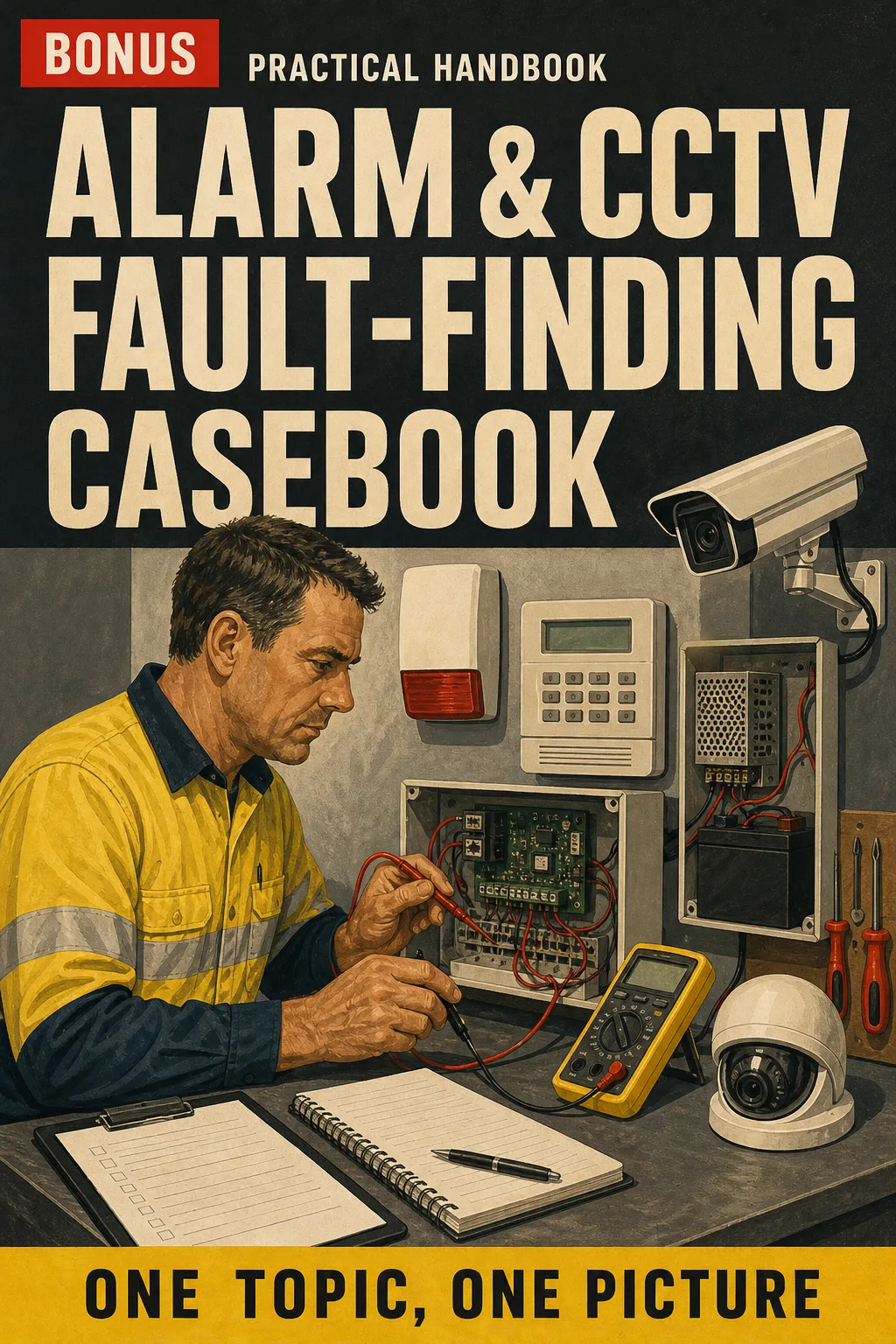
BONUS 1: «Alarm & CCTV Fault-Finding Casebook»

Value on its own: US$ 17.90

Worked fault cases to practise on, from a PIR that triggers at night to a PoE camera that keeps dropping out, so you find the cause in the same order every time.

Install Mistakes Quick Cards

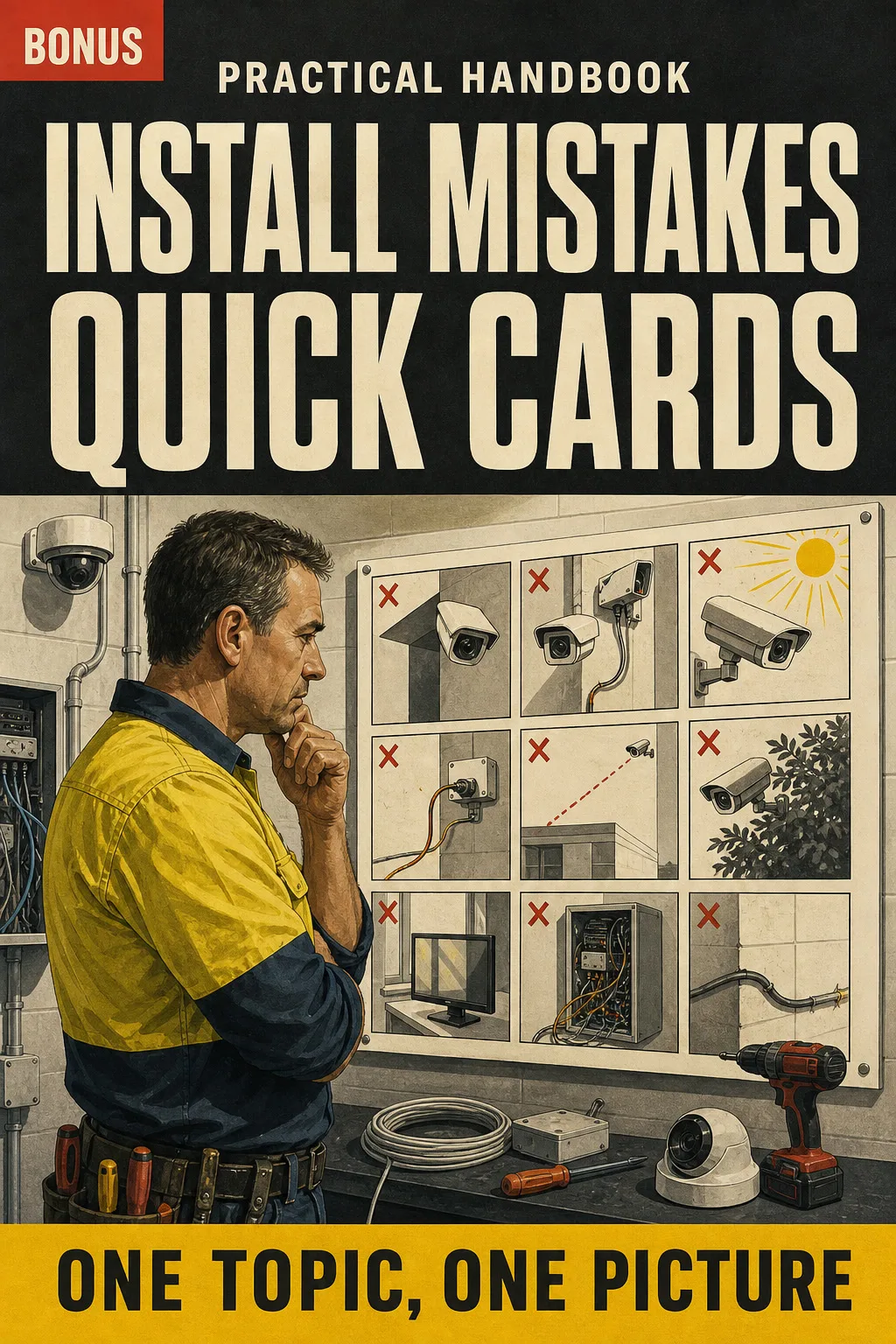
BONUS 2: «Install Mistakes Quick Cards»

Value on its own: US$ 14.90

The most frequent install errors on one card each, with the before and after drawn, ready to print and keep in the ute.

CCTV & Alarm Installation Illustrated with 2 Free Books

  • CCTV & Alarm Installation Illustrated: 67 illustrated pagesUS$ 63
  • BONUS 1: Alarm & CCTV Fault-Finding CasebookUS$ 17.90
  • BONUS 2: Install Mistakes Quick CardsUS$ 14.90
  • High-resolution PDF to printIncluded
Total value US$ 95.80
YOUR PRICE:
US$ 27
You save US$ 68.80
YES, I WANT CCTV & ALARM INSTALLATION ILLUSTRATED FOR US$ 27

📄 This is a digital PDF book sent to your email: nothing is printed or shipped.

Secure purchaseEncrypted payment30-day guarantee

PDF by email: We email you CCTV & Alarm Installation Illustrated as a PDF, together with the two free books. It's a single payment: no installments, no extra charges.

Who This Book Is For

You're adding security to your electrical work

You're adding security to your electrical work

Zones, entry delays and PoE, drawn one per page, so the security side finally reads like the rest of your trade.

You've got an alarm and cameras to quote this week

You've got an alarm and cameras to quote this week

The site walk, detector positions, lens choice and recording days in order, so the quote and the job match.

You've been installing security for years

You've been installing security for years

What you learnt on site, put in order: one page per question to keep in the ute and check before you leave the job.

Everything You Get Today

US$ 95.80US$ 27
YES, I WANT CCTV & ALARM INSTALLATION ILLUSTRATED FOR US$ 27

📄 This is a digital PDF book sent to your email: nothing is printed or shipped.

30DAYS
GUARANTEE

30-Day Guarantee

Try CCTV & Alarm Installation Illustrated for 30 days, bonus books included.

We refund everything if the file won't open, if the book isn't what you see here, if you were charged twice or if the email doesn't arrive. Just email us.

You pay once. No subscriptions.

Frequently Asked Questions

Is it for me if I'm an electrician now getting asked for alarms and cameras?

Yes. It's written for electricians, cablers and installers in Australia who already do the work: metric units, AS/NZS standards, camera angles for the Australian sun and the rules that change by state. It isn't a beginner's book: it puts the job in order, one drawn page per topic.

Where does the content come from?

It's checked against current Australian standards and guidance: AS/NZS 2201.1 for intruder alarms, AS/NZS 62676.4 and the AS 4806 series for CCTV, AS/NZS 3000, cabling rules and the Privacy Act guidance. Figures that change from state to state are flagged on the page so you can confirm them with your state regulator.

Is it official material?

No. It's an independent illustrated trade book. Standards and regulators are named only to say what the content is based on; there's no affiliation or endorsement.

Does it replace a course or a security licence?

No. It's a practical reference. Security installer licensing is set by each state and territory: check with your regulator. Mains (low voltage) work must only be done by a licensed electrician.

Are the practice cases from a licence exam?

No. The fault cases and practice material are written for this book. They aren't official questions from any exam or licence assessment.

When and how does it arrive?

The book and the 2 bonus books arrive as PDFs by email, at the address you enter at checkout.

Do I have to pay every month?

No. It's a one-off payment. No subscription.

Can I have it on paper?

Yes. The PDF is printable: print the whole book or just the pages you want in the ute.

How does the refund work?

You have 30 days. We refund everything if the file won't open, if the book isn't what you see on this page, if you were charged twice or if the email doesn't arrive: just email us.

Before You Close This Page

No more rereading spec sheets that don't stick.

PIR positions and camera angles: you see them drawn and you're done.

You arrive on the job knowing where everything is.

Drawings make studying faster.

The book is right below.

One-time payment: US$ 27 · Guarantee: 30 days · PDF by email

YES, I WANT CCTV & ALARM INSTALLATION ILLUSTRATED FOR US$ 27

📄 This is a digital PDF book sent to your email: nothing is printed or shipped.